

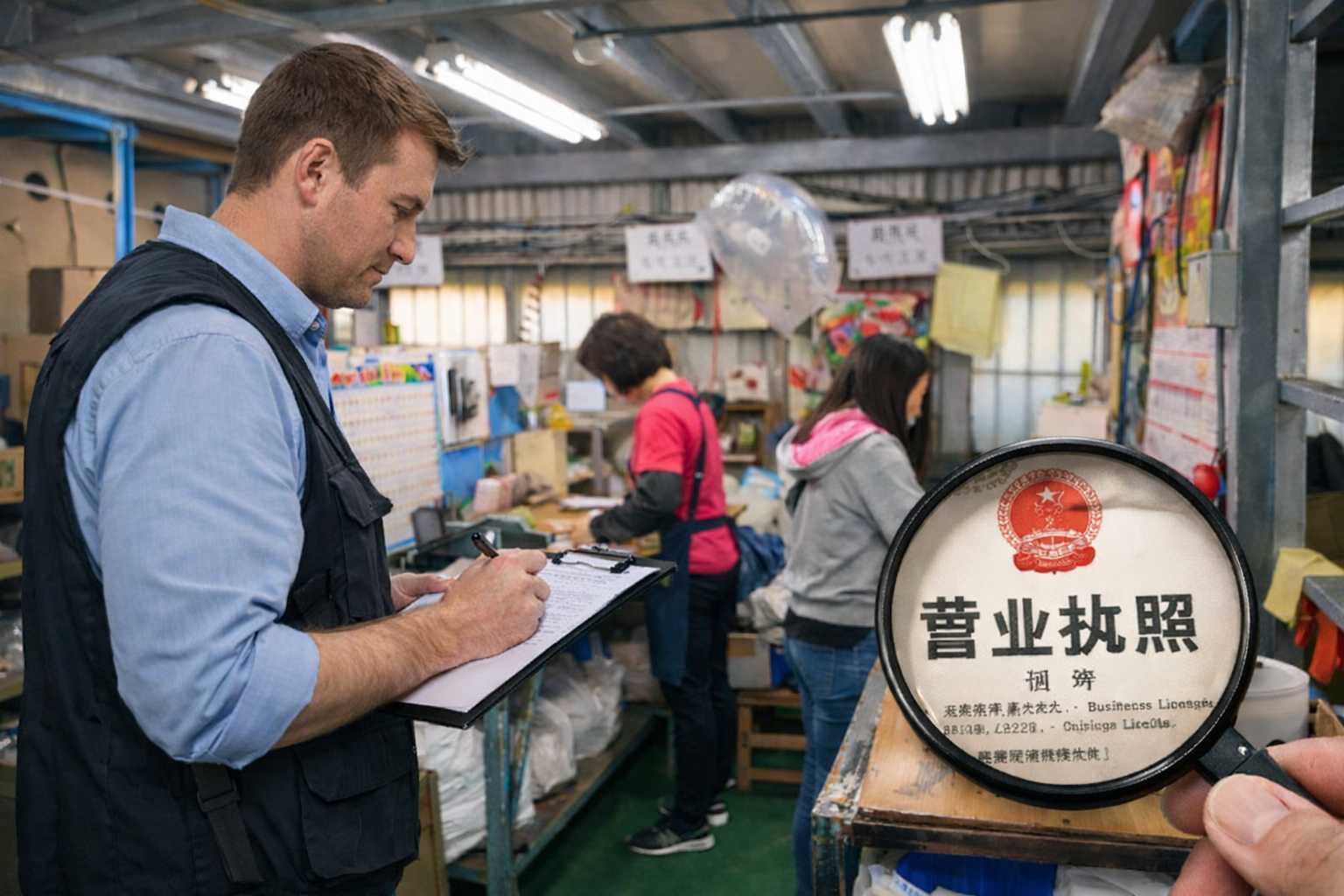
Why Supplier Verification in China Is Not a Paper Exercise – For many companies sourcing from China, supplier verification begins with paperwork — business licences, certifications, and company registration records. On the surface, these documents appear to provide reassurance that a supplier is legitimate. In reality, however, paperwork rarely tells the full story. Understanding how a supplier actually operates often requires investigation beyond documentation, particularly in complex manufacturing environments where production structures, subcontracting arrangements, and company roles are not always immediately visible.
Supplier verification in China should therefore never be treated as a simple administrative task. Many companies sourcing products internationally rely on structured buyer support services in China to confirm supplier capabilities before production begins. While documents can confirm that a company exists, they do not necessarily reveal whether that company genuinely manufactures the products it claims, operates from the facilities it lists, or has the capacity to meet production requirements.
Companies that rely solely on documentation when selecting suppliers often discover problems only after deposits have been paid or production has begun. By that stage, correcting the situation becomes significantly more difficult.
Understanding why supplier verification requires deeper investigation is essential for any company sourcing products in China.
The Limits of Documentation
When evaluating a potential supplier, most buyers begin by reviewing official documents. These often include:
- Business licences
• Company registration records
• Product certifications
• Quality management certificates
• Bank account details
These documents are important, but they provide only a partial picture.
A Chinese business licence confirms that a company is legally registered, but it does not confirm that the company actually manufactures the products it claims to produce. Many companies that appear to be factories are, in reality, trading firms that outsource production to third-party manufacturers.
Similarly, certifications such as ISO or product compliance certificates may be valid but unrelated to the specific products a buyer intends to source. In some cases, certificates belong to a different facility entirely.
Because of these limitations, many international buyers carry out deeper supplier verification before committing to production. In some cases this involves working with specialist firms that understand the local regulatory environment and manufacturing landscape. Organisations such as TCI China, for example, assist foreign companies with supplier due diligence by confirming that the business, factory location, and manufacturing capabilities match what is presented in official documentation.
Documentation should therefore be viewed as the starting point of supplier verification in China, rather thhttps://www.tcichina.co.uk/how-to-verify-if-a-supplier-in-china-is-real-or-fake/an the final step when assessing whether a supplier is genuine.
Manufacturing and Trading Are Often Blurred
One reason supplier verification requires careful analysis is that the distinction between manufacturers and trading companies in China is often unclear.
A supplier may describe itself as a factory while operating primarily as a trading company. In these cases, production is subcontracted to one or more external facilities.
While subcontracting is not necessarily problematic, it introduces additional layers of risk.
If the real manufacturing location is unknown, buyers may face several issues:
- Quality control becomes harder to manage
• Production may move between factories without notice
• Compliance certifications may not apply to the actual production site
• Intellectual property protection becomes more difficult
Without proper verification, these risks can remain hidden until problems arise.
Factory Addresses Do Not Always Tell the Full Story
Another common challenge with a supplier verification in China is verifying whether the listed factory address corresponds to the actual production site.
In China, company registration addresses may refer to administrative offices rather than manufacturing facilities. Some companies operate from shared industrial spaces or from locations different from those listed on official documents.
A supplier may provide photographs of production lines, but without confirmation of where those photographs were taken, it is impossible to know whether the facility belongs to the company in question.
On-site verification allows buyers to confirm that:
- The factory exists at the stated address
• The company occupies the premises
• The equipment and workforce match the products being produced
These details cannot be verified through documentation alone.
Production Capacity Is Often Misrepresented
A supplier may claim the ability to produce large volumes of goods, particularly when trying to secure new business. However, production capacity is one of the most difficult claims to verify remotely.
Without visiting the factory or conducting an independent inspection, buyers cannot easily determine:
- How many production lines actually exist
• Whether equipment is operational or borrowed temporarily
• Whether staff levels are sufficient to support the claimed output
• Whether the factory relies on subcontractors during busy periods
Production capacity is not just about machinery. It also forms part of a broader China supply chain strategy, where buyers must balance cost pressures with realistic production capability.
Verifying these factors requires observation and discussion with factory management, not just reviewing specifications on paper.
Supplier Verification in China – Certifications Do Not Always Reflect Reality
Many suppliers proudly display certifications such as ISO 9001, environmental certifications, or product testing reports. While these documents can indicate a level of compliance, they should not be interpreted as guarantees.
Several issues commonly arise when reviewing certifications:
- Certificates may apply only to specific products or processes
• Certification audits may have occurred several years earlier
• The certified facility may differ from the current production site
• The scope of certification may not cover the buyer’s product category
Understanding the context behind a certification is often as important as reviewing the document itself.
Subcontracting Can Create Hidden Risks
Subcontracting is common within Chinese manufacturing supply chains. A factory that appears capable of producing a particular product may outsource part or all of the production to another facility.
Subcontracting is not inherently problematic. Many industries rely on specialised subcontractors for specific processes.
However, problems occur when subcontracting happens without the buyer’s knowledge.
Undisclosed subcontracting can result in:
- Inconsistent quality standards
• Loss of traceability in the supply chain
• Production at facilities that have not been audited
• Increased risk of intellectual property leakage
In some industries this can also increase the risk of product copying or misuse of intellectual property, particularly where brands have not yet secured trademark protection in China.
Supplier verification should therefore include discussions about production processes and subcontracting practices.
Why On-Site Verification Matters
Because of these factors, supplier verification often requires more than reviewing documentation or conducting online checks.
On-site verification allows buyers to:
- Confirm the identity of the company
• Assess manufacturing capabilities
• Observe production processes
• Identify potential compliance issues
• Evaluate management practices
In practice, many companies combine supplier verification with independent factory visits or inspections. These visits help confirm whether production lines are operating as expected and whether the workforce and equipment match the supplier’s claims. Some buyers rely on third-party inspection companies, such as Goodada Inspections, to carry out factory visits and quality control checks before production begins.
These inspections may include pre-production checks, during-production inspections, or final shipment inspections depending on the level of risk involved.
When you observe the facility in operation, you gain insights that written documents cannot provide.
Building a Reliable Supply Chain
Businesses should not treat supplier verification in China as a one-time task carried out before placing an order. Instead, it forms part of a broader process of supplier evaluation and relationship management.
As supply chains become more complex, many international buyers adopt a layered approach to supplier verification. This may include initial due diligence carried out by specialist advisory firms, followed by factory audits and production inspections performed by independent quality control providers.
Combining supplier verification support from organisations such as TCI China with inspection services from companies like Goodada Inspections can help reduce the risk of misunderstandings or operational surprises later in the production process.
Companies that properly verify suppliers build more stable and reliable long-term supply chains.
Supplier Verification in China – Final Thoughts
Supplier verification in China is ultimately about understanding how a business operates in reality, not just how it appears on paper.
Documents, certifications, and online profiles can provide useful starting points, but they rarely capture the full picture of a supplier’s capabilities, production practices, or operational structure.
Companies that invest time in proper verification — supported by local knowledge, independent checks, and practical insight into the Chinese manufacturing environment — are far more likely to build reliable supply chains and avoid costly surprises.
After more than two decades of working with international firms navigating China’s supplier landscape, it remains clear that thorough, on-the-ground verification is not an optional step. It is one of the most important foundations for successful sourcing in China.
Frequently Asked Questions (FAQ)
What is supplier verification in China?
Supplier verification in China is the process of confirming that a company is legitimate, capable of producing the products it claims, and operating at the location and scale it advertises.
Why is supplier verification in China not just a paperwork exercise?
Paperwork can confirm that a company exists, but it cannot show how the business actually operates, whether it manufactures products directly, or whether it outsources production.
Can a Chinese business licence confirm that a supplier is a real factory?
A Chinese business licence confirms legal registration but does not confirm whether the company manufactures products or acts as a trading intermediary.
Why is it important to verify a supplier’s factory location?
Confirming the factory location ensures the production facility exists, belongs to the supplier, and has the equipment and workforce required for manufacturing.
Do certifications guarantee that a supplier is reliable?
Certifications can indicate compliance with certain standards but do not guarantee reliability or confirm that production practices match the certified scope.
When should supplier verification take place?
Buyers should verify suppliers before paying deposits or beginning production to confirm the supplier is legitimate and capable of meeting their requirements.