

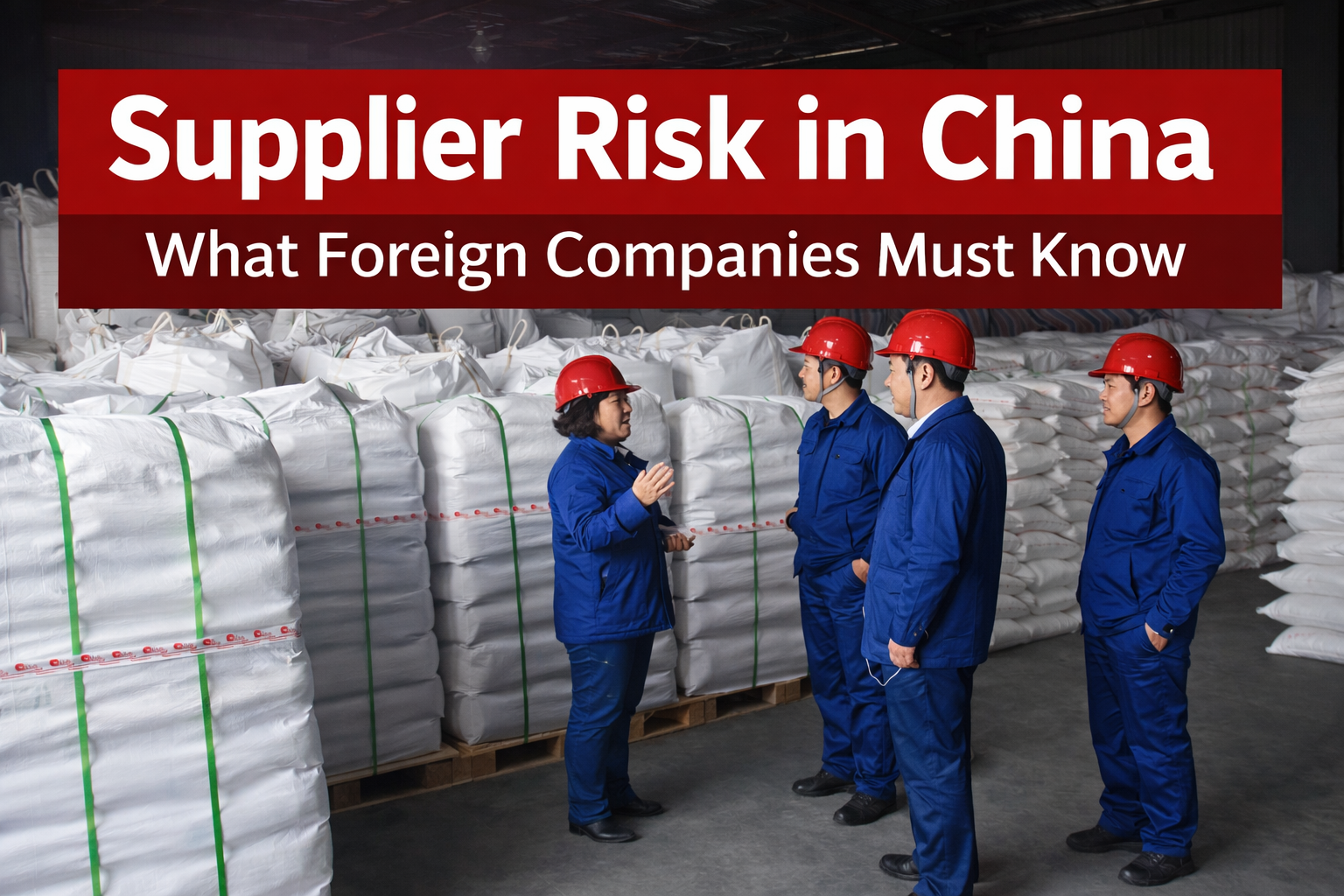
Defining the Modern Supplier Risk Landscape
The Real Risks Foreign Companies Face When Working with Chinese Suppliers – For over twenty years I’ve worked with foreign companies sourcing from China — from SMEs placing their first order, to multinational firms managing complex supply chains.
The pattern is always the same.
The first order usually goes well. The second order looks fine. The third order is where weaknesses start to show.
China is not inherently high risk. It is high leverage. When structured properly, it delivers scale, efficiency and margin. When handled casually, it exposes structural weaknesses very quickly.
If you are new to the China market, I would recommend reading our detailed guide on why local expertise is critical when doing business in China, as supplier risk and local presence are directly connected.
1. Commercial & Financial Risk
Most supplier relationships begin with competitive pricing and responsiveness. That is not where the risk lies.
The real risk emerges at scale.
Factories in China operate in an extremely competitive domestic market. Margins can be thin. Cashflow pressure is common. Many suppliers depend on continuous order flow to survive.
- 30% deposits placed with limited financial visibility
- Factories requesting accelerated balance payments
- Production delays due to internal cashflow constraints
- Suppliers closing unexpectedly after demand drops
A low unit price is not a risk strategy.
Supplier verification is not just about quality — it includes financial stability, ownership structure and operational capacity. We explain this further in our guide to building secure supplier relationships in China.
2. Quality Risk Is Not About Defects — It’s About Control
China produces some of the highest-quality products in the world. It also produces inconsistent products. The difference is rarely capability. It is systems.
- Raw materials substituted to protect margin
- Production rushed to meet shipment deadlines
- Informal internal QC systems
- Specifications interpreted differently
Factories generally produce to the level that is inspected — not the level that is expected.
If specifications are loose, quality floats. If oversight is weak, variance increases.
3. Intellectual Property Risk
China has improved its IP framework significantly. However, foreign companies still make the same mistakes.
- Tooling paid for but not legally owned
- Designs registered in the West but not in China
- Products appearing on online platforms months after production
- Factories producing extra runs for local resale
Western IP registrations do not protect you in China. If you manufacture there, you must register there. Trademark protection must be registered locally through the China National Intellectual Property Administration (CNIPA).
We break down how foreign firms structure legal and operational protection in our article on doing business in China with on-the-ground expertise.
4. Transparency & Subcontracting Risk
China’s manufacturing ecosystem is deep. A supplier may subcontract plating, assembly, packaging or even full production to a secondary facility — sometimes without disclosure.
- Undeclared subcontracting
- Compliance documentation gaps
- Unverified raw material sources
- Traceability issues
Transparency must be verified, not assumed.
5. ESG & Ethical Exposure
Ethical sourcing has shifted from brand positioning to regulatory obligation.
Modern slavery legislation, forced labour scrutiny and environmental enforcement are now embedded in Western markets.
If a supplier breaches standards, the importing company often carries the reputational consequence.
6. Geopolitical & Trade Policy Volatility
We now have to worry about tariffs, export controls and sanctions are now part of sourcing decisions not just a supplier risk in China
Concentration risk is real. Diversification and structured sourcing models are now part of prudent supply chain management.
7. Communication Risk
Most disputes do not begin with conflict. They begin with misalignment.
Email-based sourcing from overseas creates distance. On-the-ground presence changes behaviour.
This is exactly why we continue to stress the importance of having structured local representation in China when managing supplier relationships.
8. Logistics & Execution Risk
- Incorrect export documentation
- Customs holds
- Container booking delays
- Seasonal congestion
Logistics risk sits at the intersection of supplier management and freight coordination.
Structuring Supplier Risk — Not Reacting to It
Most companies only address supplier risk after something goes wrong. By then, the cost is already incurred.
TCI China works with foreign firms that want to structure their China operations properly from the outset.
- Supplier due diligence and verification
- Contract structuring support
- Risk-mapped sourcing strategies
- On-the-ground factory oversight
- Supply chain transparency audits
- IP protection advisory
- Ongoing local representation
We do not replace your procurement team. We strengthen it.
If you would like to review your current supplier exposure or build a more resilient China sourcing framework, feel free to get in touch.
Frequently Asked Questions – Supplier Risk in China
What is the biggest risk when working with Chinese suppliers?
The biggest risk is not one single issue but the absence of structured oversight. Financial loss typically results from compounded risks such as quality variability, weak contracts, and unclear intellectual property protection.
How can foreign companies reduce supplier risk in China?
Companies can reduce supplier risk by conducting due diligence, implementing enforceable bilingual contracts, registering intellectual property in China, performing independent inspections, and maintaining ongoing compliance monitoring.
Is China still high risk for sourcing?
China is not inherently high risk. It is a high-leverage manufacturing environment. With structured oversight and professional risk controls, it remains one of the most capable global sourcing markets.
Do I need to register my trademark in China if I manufacture there?
Yes. Trademarks must be registered in China to be legally protected within the country. Western registrations do not provide enforceable protection in Chinese jurisdiction.
Should companies diversify away from China?
Diversification can reduce concentration risk, but strategic decisions should be based on commercial analysis rather than reactionary policy shifts.