

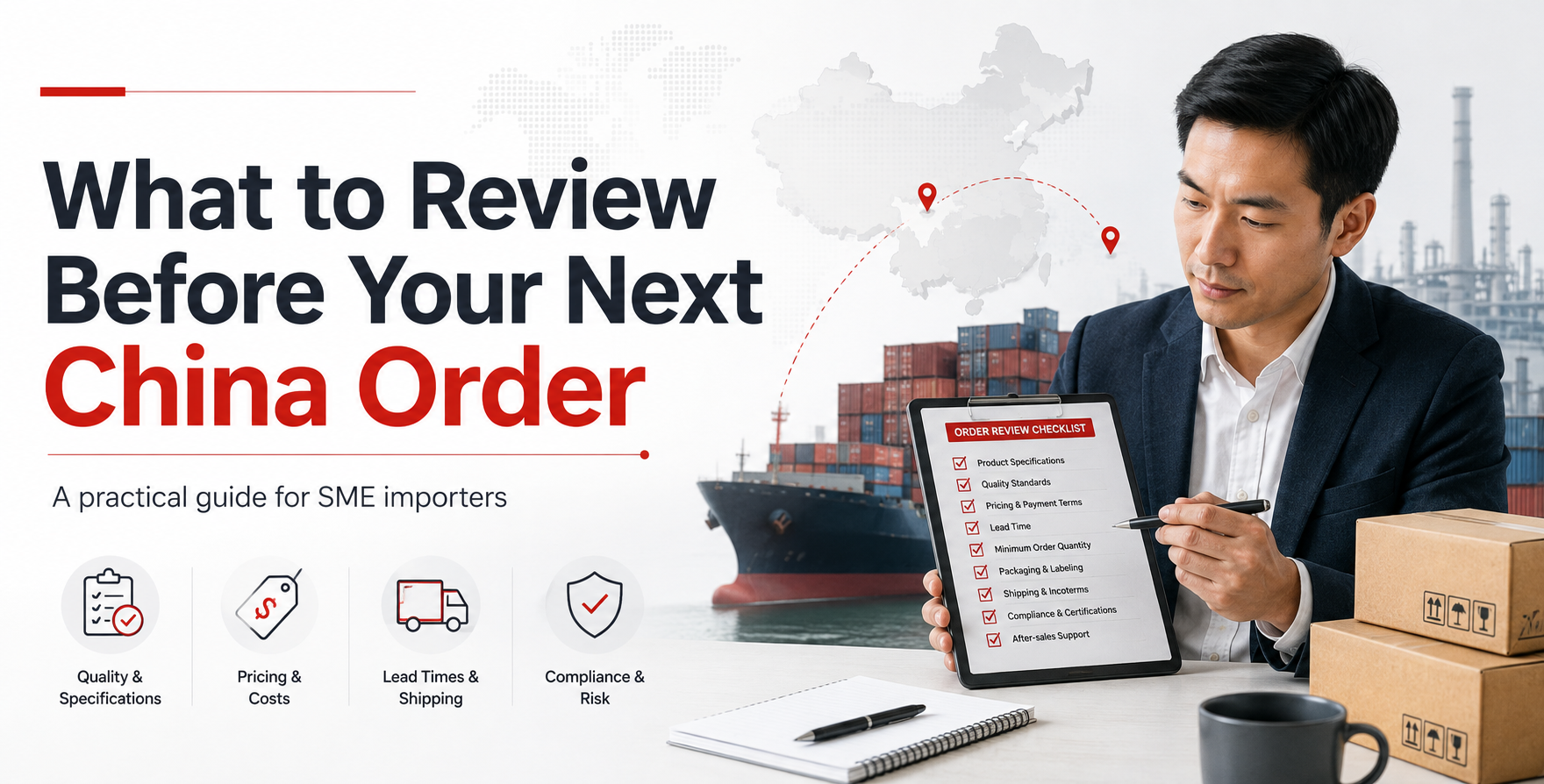
What to Review Before Your Next China Order – Placing a repeat order with a supplier in China can often feel easier than placing your first order.
You already know the supplier. The product has been manufactured before. Prices have previously been agreed, samples approved and shipments completed.
However, familiarity can also create risk.
Factories change. Staff move. Production capacity fluctuates. Material costs change. Specifications can gradually be interpreted differently. Production may be subcontracted, and small quality problems can slowly become accepted as normal.
For this reason, your next order should not simply be a repeat of your last purchase order.
It should start with a structured review of the supplier, product, commercial terms, quality controls and logistics.
Before placing another order with a China supplier, review eight key areas: your product specification, supplier capability, pricing, technical documentation, purchase terms, quality-control plan, logistics arrangements and lessons from your previous order.
For SMEs in particular, this review can help reduce unnecessary sourcing risks before money is committed.
Why SMEs Should Review Every China Order
Many small and medium-sized businesses do not have a dedicated China sourcing department.
Supplier communication, product development, purchasing, quality control, freight and payments may all be managed by the business owner, purchasing manager or operations team.
As order volumes grow, it becomes easy to repeat previous processes without questioning whether those processes are still suitable.
At TCI China, we believe China sourcing should be managed as an ongoing supply-chain process rather than a series of individual purchase orders.
Here are some of the areas we recommend reviewing before placing your next China order.
1. Review Your Product Specification
Start with the product.
Before requesting a quotation or issuing another purchase order, check that your current product specification accurately reflects what you now require.
- Dimensions and tolerances
- Materials and components
- Colours and finishes
- Product performance requirements
- Packaging
- Labelling and barcodes
- Applicable standards and certifications
- Previous defects or customer complaints
One of the first stages of TCI China’s China sourcing process is establishing the buyer’s product requirements and creating a Product Specification Sheet.
The purpose is simple: the supplier should know exactly what they are expected to manufacture.
Do not assume that because a factory made the product correctly before, everyone automatically understands the requirements for the next order.
2. Should You Review an Existing China Supplier Before Reordering?
Yes — particularly when the order is significant or the supplier has not been independently reviewed for some time.
A factory that performed well several years ago may not operate in exactly the same way today.
Consider whether:
- The same factory is still producing your goods
- Key personnel have changed
- Parts of production are being subcontracted
- Production capacity has changed
- Important equipment or processes have changed
- The supplier’s export activity appears consistent
- The business remains capable of supporting your requirements
One issue we regularly see in supply chains is buyers becoming more relaxed about supplier controls simply because the relationship has existed for several years.
A long relationship is valuable, but it should not replace basic supplier risk management.
TCI China can support SMEs through our Buying from China Consulting services, including supplier research, supplier assessment and structured sourcing support.
Where additional assurance is required, an independent supplier or factory audit can also be considered.
3. Review the Price — But Not Just the Price
It is sensible to review pricing before placing another China order.
However, the cheapest quotation does not necessarily represent the lowest overall supply-chain cost.
Ask what has changed since the previous purchase.
- Have raw materials changed?
- Has the specification changed?
- Has the minimum order quantity changed?
- Has packaging been reduced?
- Has the factory changed a component supplier?
- Has some production been subcontracted?
If a price suddenly falls significantly, understand why.
Likewise, if prices increase, ask the supplier to explain what is driving the change.
Good supplier negotiation should balance price, quality, specification, production capability, delivery and commercial risk.
TCI China’s sourcing consulting process includes manufacturer quotations, price negotiation and consultation on factory selection as part of the wider China sourcing strategy.
4. Review Samples, Drawings and Product Documentation
Before production starts, make sure the buyer and supplier are working from the same information.
Review:
- Approved samples
- Product specification sheets
- Drawings
- Artwork
- Packaging specifications
- Labelling instructions
- Test requirements
- Previous corrective actions
Remove outdated versions where possible.
If an approved sample is the production reference, confirm this clearly with the supplier.
TCI China’s supplier-engagement process can include collecting documents and drawings, reviewing supplier information, coordinating samples and facilitating communication between the buyer and seller.
These controls may appear simple, but document confusion can become an expensive production problem.
5. Review Your Purchase Terms
Many SMEs spend considerable time negotiating product prices but much less time considering what happens if the order goes wrong.
Before issuing the purchase order, review the commercial terms.
They should clearly address matters such as:
- Product specifications
- Quantity
- Pricing
- Payment terms
- Production deadlines
- Inspection requirements
- Quality expectations
- Defective goods
- Corrective action
- Intellectual property where relevant
- Responsibilities of the buyer and supplier
The purpose of strong purchase terms is not to make sourcing unnecessarily complicated.
It is to reduce ambiguity.
TCI China’s China supply-chain consulting process can also include support with detailed bilingual English and Chinese purchase contracts for businesses requiring stronger contractual controls.
6. Decide Your China Quality Control Plan Before Production
Do not wait until the goods are finished to start thinking about quality control. Before production begins, decide:
What needs to be checked, when should it be checked and what should happen if a problem is found?
Depending on the product and order risk, the quality-control programme may include:
- Raw-material or early-production checks
- During production inspections
- Production monitoring
- Finished goods inspections
- Pre-shipment inspections
- Container loading inspections
A sourcing consultant and an independent quality-control inspector perform different but complementary roles.
TCI China can help establish the supplier strategy, product requirements and quality-control plan. Goodada’s China Quality Control Inspection team can then independently visit the factory and verify whether the products meet the buyer’s agreed requirements.
Businesses can learn more about China Quality Inspection Services. It is also important to allow enough time between the final inspection and shipment.
If a problem is discovered immediately before the container is due to leave, there may be insufficient time to investigate the findings, carry out corrective work and arrange a re-inspection.
7. Review Logistics Before Production Finishes
Freight should not be left until the goods are ready.
Before production begins, confirm:
- Incoterms
- Shipping method
- Carton quantities
- Carton dimensions
- Estimated weights
- Export documentation
- Freight-forwarder responsibilities
- Planned production completion
- Required delivery date
One principle behind TCI China’s sourcing model is that sourcing, production, quality control and logistics should form one connected process.
This is particularly important for SMEs where different stages of the order may otherwise be handled independently.
8. Review What Happened on Your Previous Order
Your previous China order is one of your best sources of supply-chain information.
Ask:
- Was production late?
- Were specifications misunderstood?
- Did the inspection identify repeated defects?
- Were cartons damaged?
- Were quantities incorrect?
- Did documentation cause customs delays?
- Were there communication problems?
- Did customers identify problems after receiving the goods?
Do not simply record these issues. Convert them into controls for your next purchase order.
For example, a previous packaging defect should become a specific packaging inspection requirement. A repeated production delay may justify an earlier production check. A specification misunderstanding may require revised drawings or an updated Product Specification Sheet.
Each order should make your China supply chain stronger than the one before it.
Don’t Review the Order in Isolation — Review the Supplier Relationship
There is also a wider question to consider.
Is the supplier relationship still right for your business?
Ask yourself:
- Are you becoming too dependent on one factory?
- Are delivery times becoming longer?
- Is communication becoming more difficult?
- Are quality problems increasing?
- Do you know whether production is being subcontracted?
- Do you have an alternative supplier?
- Are your specifications and QC procedures keeping pace with your business?
- Has your purchasing volume increased without your supplier controls developing with it?
These are supply-chain questions rather than simply purchasing questions.
For a growing SME, understanding these risks can become increasingly important.
Building a Stronger China Supply Chain
Successful sourcing from China involves much more than finding a factory and negotiating a unit price.
A structured China sourcing programme connects:
Product specifications → supplier selection → negotiation → contracts → production → quality control → logistics → supplier review.
TCI China has provided China sourcing and supply-chain consulting support since 2004 and works with businesses that need either assistance with a specific China sourcing issue or more structured ongoing support.
Our Buying from China Consulting services can assist businesses with areas including supplier research, manufacturer selection, negotiations, supplier engagement and sourcing strategy.
Businesses requiring broader support can also explore our China Sourcing and Supply Chain Consulting Services.
Independent China Quality Inspection Services can then be incorporated into the sourcing process where factory-level verification is required.
Before sending your next purchase order to China, ask one important question:
What have we learned since our last order, and what should we improve before placing this one?
A short review before committing the order can be considerably easier than trying to correct a supply-chain problem after production has already started.
Frequently Asked Questions
What should I check before placing an order with a Chinese supplier?
Review the product specification, supplier capability, pricing, approved samples and documents, purchase terms, quality-control requirements, logistics arrangements and any problems experienced during previous orders.
Should I audit an existing China supplier?
An audit can be worthwhile where the order represents significant financial risk, the supplier has not been reviewed recently, production arrangements may have changed or you need greater confidence in the factory’s capabilities.
When should I arrange a China quality-control inspection?
The inspection stage depends on the product and risk. Inspections can take place during early production, while manufacturing is underway, when goods are finished or during container loading. Higher-risk orders may benefit from checks at more than one stage.
How can a China sourcing consultant help an SME?
A China sourcing consultant can support supplier research, specifications, negotiations, factory selection, supplier communication, contracts, quality planning and logistics. This can be particularly useful for SMEs that do not have their own sourcing team based in China.
Is a pre-shipment inspection enough to control product quality?
A pre-shipment inspection is an important control, but it should form part of a wider quality-management process. For some products or higher-risk orders, earlier inspections or production monitoring may identify problems before the goods are fully manufactured.