

Published: 02 October 2026 | Technical review: 02 October 2026
For many businesses buying from China, approving a supplier deposit has become a routine part of procurement.
The quotation has been agreed. Samples may have been approved. The supplier is pushing for confirmation. Production capacity is apparently being reserved, and the purchasing team wants to keep the order moving.
Finance is then asked to release the deposit.
But before that money leaves the company, management should ask a more important question:
“Do we have enough independent evidence to justify putting more of our capital at risk with this supplier?”
This is not simply a purchasing question. It is a management control question.
A competitive quotation, professional website, collection of certificates and responsive salesperson can all help build confidence. However, they do not independently establish that the supplier has the organisation, manufacturing capability, capacity, quality systems and commercial structure required to deliver the order.
The time to find that out is before the deposit is paid.
A Deposit Changes Your Commercial Position
Before paying a supplier, the buyer normally has considerable leverage.
The supplier wants the order.
You can request information. Can verify the company. Visit the factory. Question production capacity. You can review certificates. Negotiate the contract. You can investigate inconsistencies.
Most importantly, you can decide not to proceed.
Once the deposit is paid, the commercial position starts to change.
The discussion may no longer be:
“Should we place this order?”
It becomes:
“How do we get this supplier to deliver what we have already paid for?”
That is a very different management problem.
This is why companies should consider the release of a substantial supplier deposit as a control point in the sourcing process.
A deposit should be the final step in supplier approval, not the first step in discovering who the supplier really is.
A Business Licence Does Not Answer Every Question
Supplier verification is sometimes treated as little more than checking whether a Chinese business registration exists.
That is useful, but it is only the beginning.
Management needs to answer several different questions:
- Does the company legally exist?
- Is the company we are negotiating with the company named on our contract?
- Is that company actually manufacturing the goods?
- Can its factory make our particular product?
- Does it have enough capacity to deliver our quantity within the agreed period?
- Does it have suitable quality systems?
- Who will actually receive our money?
These are different questions.
A genuine registered trading company, for example, may have no manufacturing facilities of its own.
That does not automatically make it a bad supplier. Many good trading companies provide valuable sourcing and production-management services.
The issue is transparency.
Management should understand whether it is dealing directly with a manufacturer, an intermediary, or a business that intends to subcontract production.
TCI China’s China Supplier Verification Service follows this broader approach by looking beyond paperwork to help determine whether the supplier and its operating structure correspond with what has been presented to the buyer.
Contact Me if You Require Assistancel
Mobile- Messenger (Click to Connect)

Or at the following numbers:
• (Europe/ Rest of the World) +353 1 885 3919
• (UK) +44.020.3287.2990
• (North America) +1.518.290.6604
Five Risks to Consider Before Releasing the Deposit
1. Supplier Identity Risk
Start with a basic question:
Who exactly are we paying?
The company name appearing on the quotation, contract, business licence, invoice and bank beneficiary should make commercial sense together.
Differences are not automatically evidence of wrongdoing.
Chinese businesses can have different English trading names, related companies and export arrangements.
But unexplained differences require investigation.
Imagine that you believe you are purchasing directly from “ABC Manufacturing”.
The website contains photographs of a large production facility.
Your sales contact discusses “our factory”.
When the business is checked, however, you discover that the company receiving the payment is a trading company and the factory belongs to another legal entity.
Management now needs additional answers:
- Who controls production?
- Who is contractually responsible for quality?
- Who owns the tooling?
- Who is buying the raw materials?
- Can production be moved to another factory without your approval?
- Who would you pursue if the order failed?
The important point is not that using a trading company is necessarily wrong.
The problem is not knowing that you are using one.
2. Production Capability Risk
A supplier may genuinely exist and still be the wrong supplier for your product.
This is one of the more difficult sourcing risks because everything can initially appear credible.
The factory has workers. It has machinery. It exports products. Management seems professional. Samples may even look good.
But the important question is not:
“Is this a factory?”
It is:
“Can this factory consistently manufacture our product to our specifications?”
Suppose the factory mainly manufactures relatively simple products, but your order requires tighter tolerances, specialist finishing, particular materials or more sophisticated testing.
The supplier may genuinely believe it can do the work.
Its strategy may be to secure the order first and solve the technical problems later.
That transfers much of the development risk to the buyer.
A physical supplier assessment can therefore be valuable before committing to a significant order.
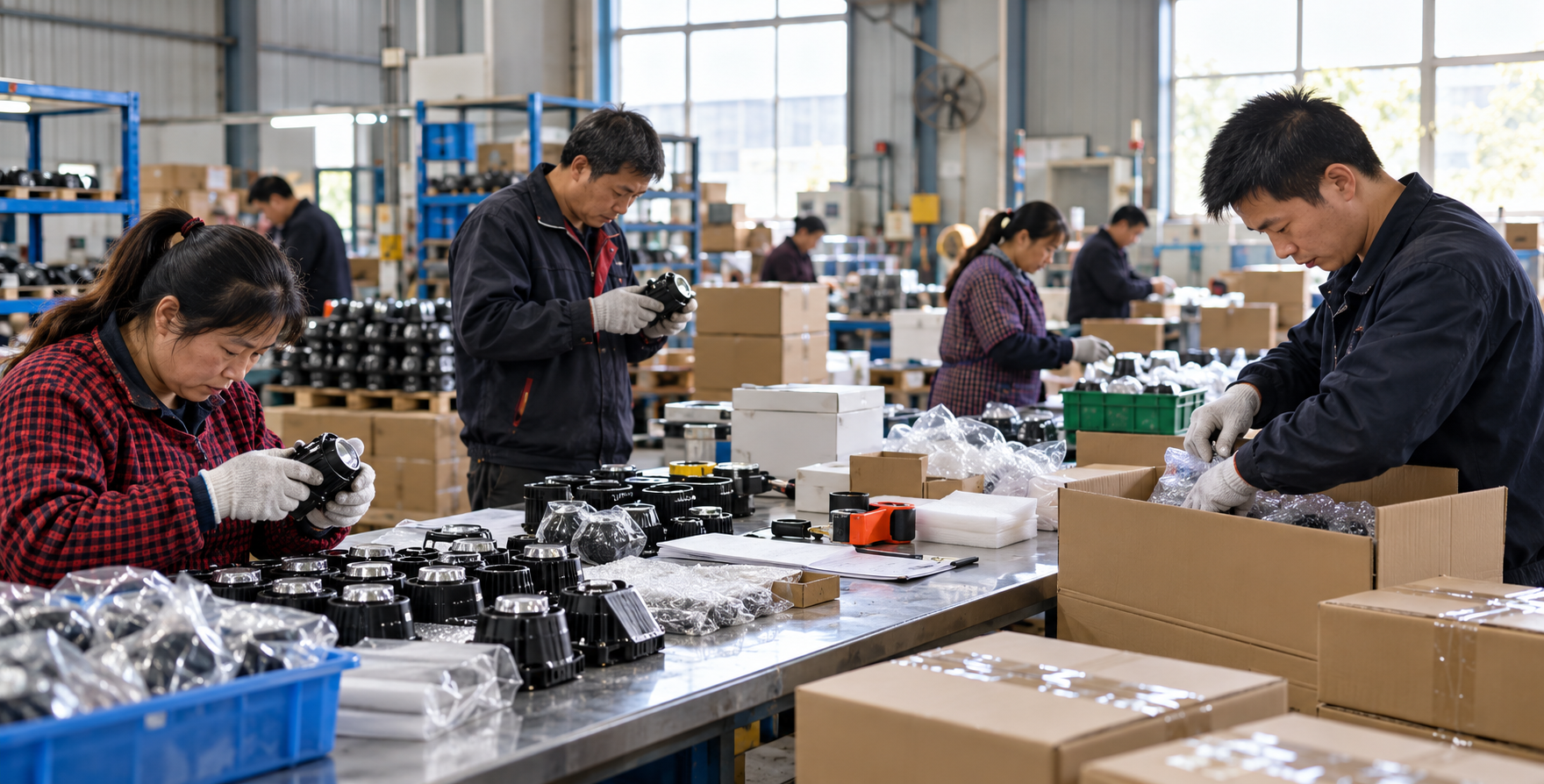
Where physical factory verification is required, Goodada’s China Quality Control and Inspection Services can help examine manufacturing operations, quality controls and the actual supplier facility rather than relying solely on information supplied remotely.
3. Production Capacity Risk
Capability and capacity are not the same thing.
A supplier may be technically capable of manufacturing 5,000 units.
That does not prove it can manufacture 50,000 units within your required delivery period.
Management should consider:
- available production lines;
- current customer commitments;
- labour availability;
- raw-material lead times;
- key machinery constraints;
- testing capacity;
- subcontracted processes;
- packing capacity;
- warehousing;
- and realistic daily output.
Suppose a supplier promises 40,000 units within 45 days.
A factory assessment subsequently shows that several production lines are already committed to other customers and some critical processes have to be subcontracted.
The issue is no longer whether the supplier can manufacture the product.
The real question becomes:
“Can the supplier manufacture our quantity, to our specification, during our required production window?”
That distinction can make the difference between a successful order and an expensive delay.
4. Quality and Compliance Risk
Certificates can provide useful evidence, but management should understand precisely what each certificate demonstrates.
Do not simply ask:
“Does the supplier have the certificate?”
Ask:
“What company, factory, product and scope does this certificate actually cover?”
Questions may include:
- Is it still valid?
- Does the legal entity match?
- Does the manufacturing address match?
- Does it cover the product being purchased?
- Does it cover the relevant production process?
- Can its authenticity be independently confirmed?
The same principle applies to product quality.
Quality control should not begin when the finished goods are sitting in cartons waiting for shipment.
Important specifications, tolerances, materials, testing requirements, workmanship standards, packaging requirements and acceptance criteria should be understood before production starts.
Where appropriate, independent inspections can then be used at different stages of production.
Goodada’s China inspection services can include supplier verification, early-production checks, during-production inspections, production monitoring, finished-goods inspections and container-loading inspections.
5. Payment Risk
The bank transfer itself deserves a control process.
If a supplier suddenly asks:
“Please send this payment to our new account”
the change should not simply be accepted because the email appears to come from the usual contact.
Management should have an independent process for verifying significant changes in beneficiary details.
There should also be a logical connection between:
Supplier → Contracting Company → Invoice → Beneficiary → Bank Account
Unusual arrangements do not automatically mean there is a problem.
But they should be explained and verified before payment is released.
The larger the financial exposure, the stronger that control should be.
The Supplier Was Real — But the Order Still Failed
One of the mistakes buyers can make is to think supplier verification is mainly about avoiding fraud.
Fraud is only one possible risk.
Many serious sourcing problems involve genuine businesses.
The Genuine Factory With the Wrong Capability
The company exists and the factory is operating.
However, its normal products are much simpler than the buyer’s product. The supplier underestimates the technical difficulty, accepts the deposit and then struggles through development during production.
The problem was not company identity.
It was capability.
The Good Sample but Insufficient Capacity
The supplier produces excellent samples.
The order is considerably larger.
When mass production begins, capacity becomes constrained. Work is rushed or passed to subcontractors.
The problem was not sample quality.
It was capacity.
The Production That Was Always “Almost Finished”
For several weeks the supplier tells the buyer that the goods are nearly complete.
Shipping is booked.
Customers are given delivery dates.
An independent factory visit eventually reveals that production is substantially behind schedule.
The problem was not necessarily deliberate dishonesty.
The management problem was that major planning decisions depended entirely on unverified supplier information.
The Unapproved Subcontractor
The buyer assesses Factory A and approves it.
Factory A receives the order.
Because its production schedule becomes overloaded, part of the work is transferred to Factory B.
Factory B was never assessed by the buyer.
Quality subsequently varies across the order.
The buyer thought it had approved a manufacturing facility.
In reality, it had approved only part of the eventual supply chain.
Management Needs Independent Evidence
A supplier may provide:
- its website;
- its brochure;
- its certificates;
- factory photographs;
- references;
- production updates;
- inspection photographs;
- and statements from its sales team.
These can all be useful.
But they essentially originate from one source:
the supplier.
For important orders, management should consider building what we call an evidence triangle.
1. Corporate Evidence
Verify the legal entity, registration information and relevant public records.
2. Documentary Evidence
Review contracts, licences, certifications, quality documents, payment information and other appropriate records.
3. Physical Evidence
Where the risk warrants it, independently confirm the factory, machinery, workforce, materials, production lines, quality-control facilities, warehouse and actual production activity.
When the three sources broadly support each other, confidence increases.
When they tell different stories, management should understand why before committing more money.
A Supplier Assessment Scorecard
Rather than approving suppliers purely on price, management can use a structured supplier-assessment model.
| Assessment Area | Weight | What Management Should Assess |
|---|---|---|
| Legal identity and ownership | 15% | Registration, company identity, address and responsible parties |
| Factory verification | 15% | Actual manufacturing facility, premises, machinery and workforce |
| Production capability and capacity | 15% | Technical ability, machinery, workload, output and bottlenecks |
| Quality management | 10% | QC staff, procedures, records, testing and defect controls |
| Certification and compliance | 10% | Validity, scope and relevance of certifications |
| Payment and financial risk | 10% | Beneficiary, banking consistency and payment arrangements |
| Management capability | 10% | Experience, organisation, communication and production management |
| Subcontracting transparency | 5% | Outsourced processes and third-party manufacturing |
| IP and tooling protection | 5% | Drawings, tooling, trademarks and confidentiality |
| Commercial history | 5% | Experience, customers, export history and track record |
| Total | 100% |
Each area can be scored from zero to five:
- 5 – Strong evidence and well controlled
- 4 – Good, with minor weaknesses
- 3 – Acceptable but requires controls
- 2 – Material concerns
- 1 – Significant risk
- 0 – Unverified or unacceptable
However, management should never allow a numerical score to override a serious red flag.
A supplier could theoretically achieve a respectable overall score while still asking for payment to an unexplained third-party account.
That should trigger investigation regardless of the mathematics.
Examples of Automatic HOLD Conditions
- The legal company cannot be satisfactorily verified.
- The supplier refuses to disclose where production takes place.
- The payment beneficiary cannot be reasonably explained.
- An important certificate appears false or materially misleading.
- The supplier prevents reasonable factory verification.
- Manufacturing is taking place somewhere different from the disclosed factory.
- Significant subcontracting has not been declared.
- The contracting company differs materially from the business assessed.
The Bigger Question: How Healthy Is Your China Sourcing Process?
Assessing an individual supplier is important.
But management should also step back and examine the system surrounding all of its China purchasing.
A company can have good suppliers and still have a weak sourcing process.
For example:
- Who approves a new supplier?
- Who can authorise deposits?
- Are contracts used consistently?
- How are specifications controlled?
- When are suppliers independently checked?
- How is production progress verified?
- Who decides when inspections are required?
- What happens when a supplier changes a factory or subcontractor?
- How are quality problems escalated?
- How often is supplier performance reviewed?
TCI China uses a China Sourcing Health Check to help businesses examine these wider controls.
The company’s Buying from China services are structured around supplier verification, sourcing support, contracts, quality control and broader sourcing management rather than treating individual sourcing problems in isolation.
China Sourcing Health Scorecard
| China Sourcing Control | Weight |
|---|---|
| Supplier verification | 15% |
| Contracts and commercial controls | 15% |
| Payment and deposit controls | 10% |
| Production visibility | 15% |
| Quality control | 15% |
| Product compliance | 10% |
| Supplier concentration | 5% |
| IP and tooling protection | 5% |
| Logistics and shipment controls | 5% |
| Management information | 5% |
| Total | 100% |
This moves the discussion away from:
“Do we have a good supplier?”
towards:
“Do we have a sourcing system capable of identifying problems before those problems become expensive?”
Price Is Not the Same as Cost
Supplier decisions are often dominated by unit price.
Consider two suppliers:
Supplier A: $500,000
Supplier B: $475,000
Supplier B appears to offer a $25,000 saving.
But suppose the lower-priced supplier subsequently creates:
- a four-week production delay;
- rework;
- expedited freight;
- customer delivery problems;
- additional inspections;
- management time;
- and rejected products.
The $25,000 procurement saving may disappear very quickly.
Management should therefore consider the risk-adjusted cost of the supplier, rather than simply the quoted purchase price.
True Supplier Cost = Purchase Price + Quality Risk + Delivery Risk + Compliance Risk + Management Cost + Recovery Cost
Those risks cannot always be reduced to a precise financial number.
The purpose of the exercise is to prevent a small visible saving from obscuring much larger hidden risks.
Supplier Due Diligence Should Not Be a One-Time Exercise
A supplier that performed well three years ago should not automatically be assumed to have the same risk profile today.
Businesses change.
Ownership changes. Managers leave. Factories relocate. Equipment ages. Order books become overloaded. Processes are subcontracted. Financial pressures increase. Product requirements change.
A practical supplier-management system should therefore include periodic review.
Additional verification should also be considered when particular events occur, such as:
- moving to a new supplier;
- placing a substantially larger order;
- introducing a new product;
- changing the manufacturing facility;
- changing bank details;
- repeated quality failures;
- unexplained production delays;
- ownership changes;
- or unexpected subcontracting.
No Verification. No Deposit.
Management does not need to eliminate every sourcing risk.
That would be unrealistic.
The objective is to identify important risks early enough to make an informed commercial decision and put appropriate controls around them.
Before approving a significant deposit with a new Chinese supplier, management should therefore be comfortable with six areas:
Identity → Capability → Capacity → Compliance → Payment → Control
If important information remains unclear, investigate it while you still have maximum commercial leverage.
Because the cheapest point at which to discover a supplier problem is usually before you transfer the deposit.
How Healthy Is Your China Sourcing Process?
TCI China has worked with companies buying from and operating in China since 2004.
The approach is to help businesses introduce greater structure, supplier control and sourcing discipline rather than relying on reactive problem-solving after an order has already gone wrong.
TCI China’s Buying from China services include sourcing support, supplier verification, commercial support and China sourcing management.
If you already buy from China, the TCI China Sourcing Health Check can help you examine where your current purchasing process may be exposed.
It can help management consider areas such as:
- supplier verification;
- payment controls;
- supplier management;
- contracts;
- production visibility;
- quality control;
- and wider China sourcing risk.
Take the TCI China Sourcing Health Check
Where physical supplier verification or product inspection is required, Goodada Inspections can also provide independent factory audits and quality-control inspections at supplier locations across China.
The objective is not simply to confirm that a supplier exists.
It is to give management enough independent information to decide whether that supplier should be trusted with the company’s money, product, production schedule and reputation.