

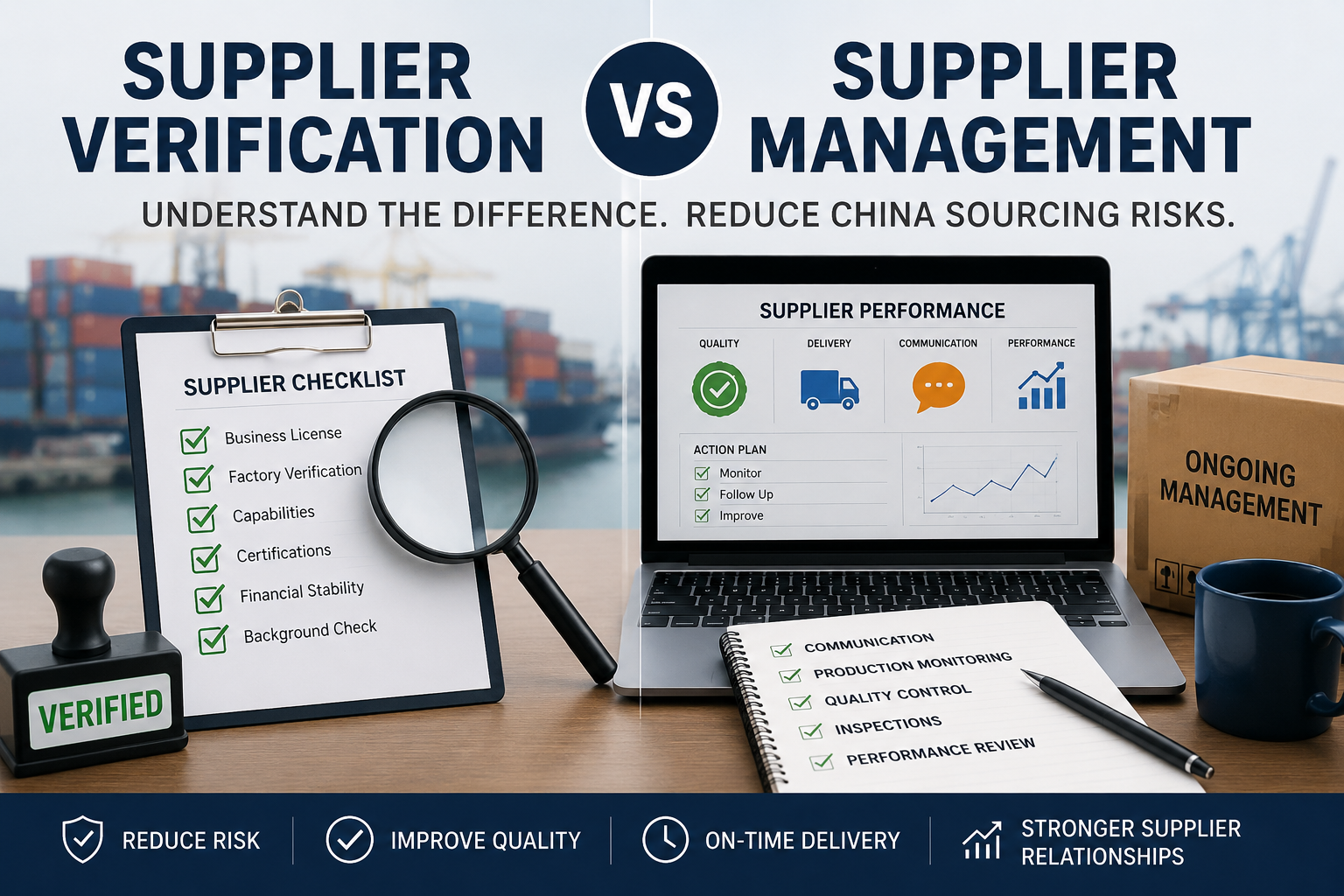
Supplier Verification vs Supplier Management: What Is the Difference?
When a business starts buying from China, one of the first questions it often asks is:
“Is this supplier real and reliable?”
That is a sensible question.
Before paying deposits, sharing product information, or placing an order, a buyer needs to know whether the supplier is genuine, whether the business exists, whether the factory or trading company is suitable, and whether there are any obvious warning signs.
This is where supplier verification is important.
But there is another question that becomes just as important once sourcing activity grows:
“How do we manage this supplier properly over time?”
That is where supplier management comes in.
Supplier verification and supplier management are closely connected, but they are not the same thing. A Supplier verification helps you check who you are dealing with. While a Supplier management helps you control how that supplier performs after the relationship begins.
For companies sourcing from China, understanding the difference can help prevent a common mistake: assuming that one supplier check at the start is enough to protect future orders.
It rarely is.
What is a Supplier Verification?
Supplier verification is the process of checking whether a supplier is genuine, suitable, and commercially credible before you proceed too far.
It is usually carried out before placing an order, before paying a deposit, or before moving from initial discussion to a more serious supplier relationship.
A supplier verification check may look at areas such as:
- whether the company exists;
- whether the business registration details are consistent;
- whether the supplier is a manufacturer, trading company, or intermediary;
- whether the supplier’s address, business scope, and contact details make sense;
- whether there are obvious red flags;
- whether the supplier appears capable of supplying the product;
- whether the buyer should proceed, pause, or carry out deeper checks.
Where the buyer needs a deeper review of the production site, a Factory Audit can help assess whether the factory is suitable before larger orders are placed.
Supplier verification is important because it helps reduce the risk of dealing with unsuitable or misleading suppliers.
For example, a buyer may believe they are speaking directly with a factory, but later discover the supplier is actually a trading company. That does not automatically mean the supplier is bad. Many trading companies can be useful. But the buyer needs to know who they are dealing with, because it affects pricing, communication, production control and accountability.
Supplier verification helps bring clarity at the start.
It is a first layer of protection.
What a Supplier Verification does not do
Supplier verification is useful, but it has limits.
It does not guarantee that every future order will go smoothly.
A supplier may be real, properly registered and capable of producing the product, but still perform poorly later. They may miss deadlines, misunderstand specifications, change materials, communicate badly, subcontract production, or fail to follow agreed quality standards.
This is why supplier verification should not be treated as the end of supplier risk control.
It answers an important question:
“Should we consider working with this supplier?”
It does not fully answer:
“How do we manage this supplier every month, every order and every problem?”
That is the role of supplier management.
What is Supplier Management?
Supplier management is the ongoing process of managing supplier performance after the initial supplier relationship begins.
It includes how you communicate with suppliers, how you confirm requirements, how you manage purchase contracts, how you monitor production, how you plan inspections, how you follow up on quality issues, and how you decide whether to continue, improve or replace a supplier.
Supplier management can include:
- regular supplier communication;
- reviewing supplier performance;
- confirming specifications before production;
- making sure purchase contracts are clear;
- checking whether suppliers follow agreed terms;
- arranging quality inspections at the right stage;
- reviewing inspection findings;
- following up on corrective actions;
- monitoring repeated problems;
- managing supplier dependency;
- deciding when a supplier needs to be replaced.
In simple terms, supplier verification is a check.
Supplier management is a system.
Verification helps you avoid starting with the wrong supplier. Management helps you avoid losing control of the supplier relationship over time.
Why the difference matters when buying from China
Many sourcing problems do not happen because the supplier was fake.
They happen because the supplier was not properly managed.
For example, a supplier may be legitimate but still produce goods that do not match the approved sample. A factory may exist and have production capability, but still miss deadlines. A supplier may communicate well during the sales process, but become slower or less transparent after the deposit has been paid.
These are not always verification issues.
They are often supplier management issues.
This distinction matters because the solution is different.
If the problem is that the supplier is not genuine, supplier verification may help identify that before the buyer proceeds.
Where supplier management issues relate to product quality, buyers may also need independent China Quality Control Inspections to check whether goods meet agreed requirements before shipment.
If the problem is that the supplier is real but unreliable, the buyer needs better supplier management.
That may include clearer contracts, stronger communication, better inspection planning, and more structured follow-up.
Example: verified supplier, poor management
Imagine a company finds a supplier in China for a private-label product.
The supplier is checked and appears genuine. The registration details are consistent. The supplier has product experience. The initial sample is acceptable. The buyer places an order.
So far, supplier verification has done its job.
But then the problems start.
The supplier gives vague production updates. Packaging artwork is changed at the last minute. The buyer assumes the supplier is using the approved sample as the production standard, but this is not clearly stated in the purchase contract. The final inspection finds several issues. The supplier offers to correct some of them, but the shipment is already delayed. A Finished Goods Inspection, also known as a pre-shipment inspection, can help buyers check product condition, packaging, labelling and workmanship before goods leave the supplier.
In this situation, the issue was not necessarily that the supplier was fake or unsuitable from the beginning.
The issue was that the supplier relationship was not managed tightly enough.
There may have been gaps in communication, contracts, quality control, inspection timing and follow-through.
That is supplier management.
Supplier verification is usually event-based
Supplier verification is usually done at a specific point in time.
It may happen before:
- paying a deposit;
- placing a first order;
- approving a new supplier;
- moving to a higher order value;
- sharing sensitive product information;
- switching from one supplier to another.
It is often a project-based task.
The buyer wants to know whether the supplier is who they say they are and whether there are obvious concerns before moving forward.
That makes supplier verification highly useful at the start of the relationship.
However, because it is usually event-based, it can become outdated.
A supplier that looked suitable two years ago may not be suitable today. Their ownership, management, production capacity, financial position, quality systems, or attitude to your business may have changed.
That is another reason why supplier management matters.
Supplier management is ongoing
Supplier management does not stop after the supplier has been checked.
It continues across the relationship.
It asks questions such as:
- Is the supplier still performing well?
- Are they responding clearly and on time?
- Are they following purchase contract requirements?
- Are quality issues increasing or decreasing?
- Are delivery dates being met?
- Are inspection findings being properly addressed?
- Is the supplier becoming more or less reliable?
- Are we too dependent on this supplier?
- Do we need an alternative supplier?
This is particularly important for businesses placing repeat orders from China.
A one-off supplier verification check may reduce initial risk, but it will not manage future orders by itself.
If China sourcing has become important to your business, supplier management becomes a continuing business discipline.
Where Supplier Verification fits into Supplier Control
Supplier verification is part of supplier control, but it is not the whole process.
A sensible supplier control process may look like this:
- Identify a potential supplier.
- Carry out supplier verification.
- Review product capability and suitability.
- Agree specifications, pricing and commercial terms.
- Use a clear purchase contract.
- Confirm samples and production requirements.
- Monitor production communication.
- Arrange inspections where needed.
- Review findings and supplier performance.
- Carry lessons into the next order.
Supplier verification sits near the beginning.
Supplier management runs through the entire process.
This is why businesses that source from China regularly should avoid treating supplier verification as a standalone safeguard. It is a useful starting point, but the wider supplier control system is what protects the business over time.
Why Supplier Management is often overlooked
Supplier management is often overlooked because it does not feel urgent at the start.
When a buyer is excited about a new product, the focus is often on price, samples, lead time and getting the order moving.
Supplier management feels like something to worry about later.
But “later” often arrives when there is already a problem.
The supplier misses a deadline. The product does not match the sample. Packaging is wrong. The supplier does not reply clearly. The inspection report raises issues. The buyer realises the purchase contract was too weak.
At that point, the business is reacting.
A better approach is to put supplier management structure in place before the problem appears.
That does not mean making the process complicated. It means having clear expectations, clear documents, clear communication and clear follow-up.
Signs your business needs more supplier management
Your business may need stronger supplier management if you recognise any of the following signs:
- supplier communication is becoming harder to control;
- one person inside the business is carrying all supplier knowledge;
- the same quality issues keep appearing;
- suppliers agree to terms but do not follow them properly;
- purchase contracts are too basic;
- inspection findings are not carried into future orders;
- production updates are vague;
- delivery dates are often uncertain;
- supplier problems are taking too much management time;
- you are not sure whether your current suppliers are still the right fit.
These are not always signs that you chose the wrong supplier.
They may be signs that your sourcing process has outgrown casual supplier management.
Supplier verification vs supplier management: comparison table
| Area | Supplier Verification | Supplier Management |
|---|---|---|
| Main purpose | Checks whether the supplier is genuine and suitable | Controls supplier performance over time |
| Timing | Usually before an order or early in the relationship | Ongoing throughout the supplier relationship |
| Main question | Is this supplier who they say they are? | Is this supplier performing properly? |
| Type of support | Event-based check | Continuous process |
| Helps with | Red flags, basic credibility, supplier identity and suitability | Communication, contracts, quality, delivery, inspections and follow-up |
| Best used when | Considering a new supplier or higher-risk transaction | Buying regularly or managing repeat orders |
| Main limitation | Does not guarantee future performance | Requires consistent follow-through and management discipline |
Why both are needed
A good sourcing process should include both supplier verification and supplier management.
Supplier verification helps you avoid obvious problems before you begin.
Supplier management helps you keep control after the relationship starts.
The problem is that many companies do the first part, but not the second.
They check the supplier once, place the order, and then assume the relationship will manage itself.
But supplier relationships do not manage themselves.
They need structure.
That structure may include clearer specifications, stronger purchase contracts, better communication, inspection planning, corrective action follow-up and regular supplier performance review.
This is especially important when a business is working with multiple suppliers, placing repeat orders, developing private-label products, or relying on China as an important part of its supply chain.
How monthly consulting supports supplier management
For businesses buying from China regularly, monthly consulting can help create more structure around supplier management.
This is where TCI China’s Monthly Silver Consulting and Monthly Gold Consulting services are relevant.
Silver Monthly China Consulting may be suitable for businesses that need regular support with supplier communication, sourcing decisions, purchase contracts, inspection coordination and follow-through.
It can be a practical option for growing importers that are not ready to build a full internal China sourcing team, but have outgrown one-off support.
Gold Monthly China Consulting may be more suitable for companies with a broader or more complex China sourcing operation. This may include several suppliers, multiple product categories, more frequent sourcing issues, or a need for deeper involvement in supplier control.
The purpose of monthly consulting is not to replace the buyer’s commercial decision-making.
The purpose is to help the business manage suppliers with more structure, better visibility and clearer follow-through.
Supplier verification vs supplier management: the simple difference
The simplest way to understand the difference is this:
Supplier verification asks:
“Can we trust this supplier enough to consider working with them?”
Supplier management asks:
“How do we keep this supplier relationship controlled over time?”
Supplier verification helps reduce the risk of choosing the wrong supplier.
Supplier management helps reduce the risk of poor performance after the supplier has been chosen.
Both matter.
But they solve different problems.
A business that only verifies suppliers may still face repeated quality issues, weak communication, contract problems and production delays.
A business that manages suppliers properly is more likely to identify problems earlier, set clearer expectations and make better decisions about whether to continue, improve or move away from a supplier.
Which does your business need?
If you are dealing with a new supplier, supplier verification is usually the first step.
When you are already buying from China and facing repeated issues, supplier management may be the bigger gap.
If you are unsure, ask yourself:
- Do we know who our suppliers really are?
- Do we know whether they are still suitable?
- Are our contracts strong enough?
- Are our quality requirements clearly documented?
- Are inspections planned at the right stage?
- Do we follow up properly after problems?
- Are supplier issues repeating?
- Are we managing suppliers proactively or reacting to problems?
The answers will usually show where your supplier control gaps are.
Final thoughts
Supplier verification and supplier management are both important parts of sourcing from China, but they should not be confused.
Verification is about checking the supplier before you move forward.
Management is about controlling the supplier relationship after you move forward.
For simple, occasional sourcing, supplier verification and one-off support may be enough.
But for businesses placing repeat orders, working with multiple suppliers, or relying on China as a key supply base, supplier management becomes essential.
The real risk is not only choosing the wrong supplier.
It is also failing to manage the supplier properly once the relationship begins.
If your business is experiencing repeated supplier communication issues, quality concerns, weak contract follow-through, or too much internal pressure around China sourcing, it may be time to review your supplier control process.
For more informaiton please read some of our other articles:
- 7 Signs Your business Needs Ongoing China Sourcing Support
- Supplier Verification in China, Why it is not Just a paper Excercise
- Adhoc Buying in China
Discuss your supplier control gaps
TCI China supports businesses that want to improve how they manage suppliers in China.
If your company is unsure whether the issue is supplier verification, supplier management, or wider sourcing control, we would be happy to discuss your supplier control gaps and help you identify practical next steps.
You can learn more about our monthly support options here:
Frequently Asked Questions
What is the difference between supplier verification and supplier management?
Supplier verification checks whether a supplier is genuine, suitable and commercially credible before you proceed. Supplier management is the ongoing process of managing supplier communication, contracts, quality, delivery performance, inspections and follow-up after the relationship begins.
Is supplier verification enough when buying from China?
Supplier verification is important, but it is not enough by itself for businesses buying from China regularly. It helps reduce the risk of starting with the wrong supplier, but it does not guarantee that future orders will be managed properly.
When should a business carry out supplier verification?
Supplier verification should usually be carried out before placing a first order, paying a deposit, increasing order value, sharing sensitive product information, or committing to a new supplier relationship.
What does supplier management include?
Supplier management can include regular supplier communication, purchase contract follow-up, production monitoring, inspection planning, quality issue review, corrective action follow-up, supplier performance review and decisions about whether to continue, improve or replace a supplier.
Can a verified supplier still cause problems?
Yes. A supplier can be genuine and still cause problems. They may miss deadlines, misunderstand specifications, change materials, communicate poorly, subcontract production, or fail to meet agreed quality standards. This is why supplier management is important.
Why is supplier management important for China sourcing?
Supplier management is important because many China sourcing problems happen after the supplier has already been selected. Strong supplier management helps buyers control communication, quality, contracts, delivery and follow-through across repeat orders.
What are signs that my business needs better supplier management?
Signs include repeated quality issues, vague production updates, weak contract follow-through, supplier communication problems, inspection findings not being addressed, missed delivery dates, and too much internal time being spent chasing suppliers.
Does supplier management replace supplier verification?
No. Supplier verification and supplier management should work together. Verification helps you check the supplier before proceeding. Management helps you control the supplier relationship after the relationship begins.
When does a business need monthly supplier management support?
Monthly supplier management support may be useful when a business is buying from China regularly, working with multiple suppliers, facing repeated issues, or relying on China as an important part of its supply chain.
How can TCI China help with supplier control?
TCI China can help businesses review supplier control gaps, improve supplier communication, strengthen purchase contract discipline, coordinate quality control and inspections, and provide ongoing monthly support through Silver or Gold Monthly China Consulting.